


What Is Collagen Supplement ODM?
Collagen supplement ODM refers to an Original Design Manufacturing model used by supplement brands that want support not only with production, but also with product planning and development. Depending on the manufacturer's capabilities, a collagen supplement ODM project may include concept development, collagen source selection, formula design, flavor development, dosage form selection, pilot sampling, packaging coordination, quality testing, mass production, and documentation.
In practical terms, a brand may approach a collagen supplement ODM manufacturer with an idea such as “we want a berry-flavored collagen powder for working professionals” or “we want a convenient daily collagen stick pack.” The ODM manufacturer then helps translate that concept into a manufacturable product based on ingredient compatibility, dosage form, processing requirements, target cost, packaging, minimum order quantity, and the regulations of the intended sales market.
This model can be especially useful for start-up brands, beauty companies, distributors, pharmacies, wellness businesses, e-commerce operators, and established companies expanding into nutritional products. Instead of building an entire research, procurement, manufacturing, and quality-control system internally, the brand can work with an experienced partner that already has the relevant production infrastructure.
Key Point: A collagen supplement ODM project should not be evaluated only by whether a factory can manufacture collagen. The more important question is whether the manufacturer can support product development, quality documentation, stable production, packaging coordination, and the requirements of your target market.
Why Do Brands Use Collagen Supplement ODM?
Launching a collagen supplement involves much more than purchasing collagen peptides and putting them into a container. A commercially viable product requires decisions about formula positioning, ingredient combination, serving size, taste, texture, packaging, shelf stability, production feasibility, documentation, quality standards, and market positioning. These decisions can become complex for a brand entering the supplement industry for the first time.
1. Reduce Product Development Complexity
A capable collagen supplement ODM company can help organize the development process from an initial product concept to a production-ready specification. This can reduce the number of separate suppliers a brand needs to coordinate and make communication between formulation, ingredient procurement, testing, manufacturing, and packaging more efficient.
2. Access Existing Manufacturing Infrastructure
Building a supplement manufacturing facility requires significant investment in equipment, quality systems, personnel, sanitation, production controls, and testing procedures. Working with an established ODM manufacturer allows a brand to use existing manufacturing infrastructure rather than developing these capabilities from zero.
3. Create More Distinctive Product Concepts
Collagen products can be differentiated through collagen source, molecular characteristics, flavor, complementary ingredients, serving format, packaging design, target audience, and consumption scenario. A good collagen supplement ODM partner should be able to discuss how these variables affect both manufacturing feasibility and market positioning rather than simply offering one standard formula to every brand.
4. Improve Project Coordination
Supplement development often requires coordination among ingredient suppliers, formulators, quality teams, packaging vendors, designers, testing laboratories, and production planners. An ODM model may centralize much of this coordination, which can be useful when the brand does not have a large internal product-development team.
Collagen Supplement ODM vs. OEM: What Is the Difference?
ODM and OEM are sometimes used interchangeably in supplement sourcing conversations, but they describe different levels of manufacturer involvement. The exact service scope varies from supplier to supplier, so brands should always confirm what is actually included in a quotation.
| Comparison | Collagen Supplement ODM | Collagen Supplement OEM |
|---|---|---|
| Product concept | Manufacturer may assist with concept development | Brand often provides a clearer existing specification |
| Formula development | Usually an important part of the service | May focus more heavily on manufacturing an established formula |
| Ingredient selection | Often supported by the manufacturer | May follow brand-specified ingredients |
| Sampling | Commonly involves iterative prototype development | Usually verifies manufacturability of the supplied specification |
| Best suited for | Brands requiring product-development support | Brands that already have a more complete product specification |
Neither model is automatically better. If your brand already owns a mature formula and only needs stable contract manufacturing, an OEM-style arrangement may be sufficient. If you still need help deciding the formula, flavor, ingredient combination, dosage form, and packaging direction, collagen supplement ODM is usually the more relevant conversation to have.
How Does Collagen Supplement ODM Work? 5-Step Process
The exact workflow varies by manufacturer, but most collagen supplement ODM projects can be organized into five major stages. Understanding these stages before requesting a quotation helps a brand prepare better information and reduces unnecessary revisions later.
Step 1: Define the Product Brief
Start with the target customer, intended dosage form, sales channel, target retail price, expected positioning, target market, desired packaging, and approximate order volume. Instead of simply asking for “a collagen product,” provide a more specific brief such as a low-sugar collagen powder in individual sachets for online retail or a convenient capsule product designed for travel.
Step 2: Develop the Formula
The collagen supplement ODM team can then evaluate collagen source, serving amount, complementary ingredients, flavor system, sweetener system, solubility, texture, capsule capacity, tablet size, or other technical variables. Formula development must balance marketing expectations with manufacturing reality. Adding too many ingredients, for example, may increase serving size, affect flavor, reduce stability, or push the product beyond its cost target.
Step 3: Produce and Evaluate Samples
Sampling allows the brand to evaluate flavor, aroma, color, powder dispersion, mouthfeel, serving convenience, capsule size, tablet dimensions, or other sensory and physical characteristics. One sample is not always enough. Brands should expect formulation development to involve practical trade-offs between taste, ingredient quantity, format, production capability, and target cost.
Step 4: Confirm Specifications, Packaging, and Documentation
Once a sample is approved, the project should move into specification confirmation. Important items may include raw-material specifications, formula composition, finished-product specification, packaging material, label content, unit weight, serving size, batch size, testing plan, shelf-life considerations, and required documents. The specific regulatory and labeling requirements depend on the market where the product will be sold.
Step 5: Mass Production and Quality Release
After the commercial specifications, purchase order, artwork, and production schedule are confirmed, the manufacturer can proceed with mass production. A professional project should have defined production records, quality checks, packaging controls, lot identification, and finished-product release procedures appropriate to the product category and target market.
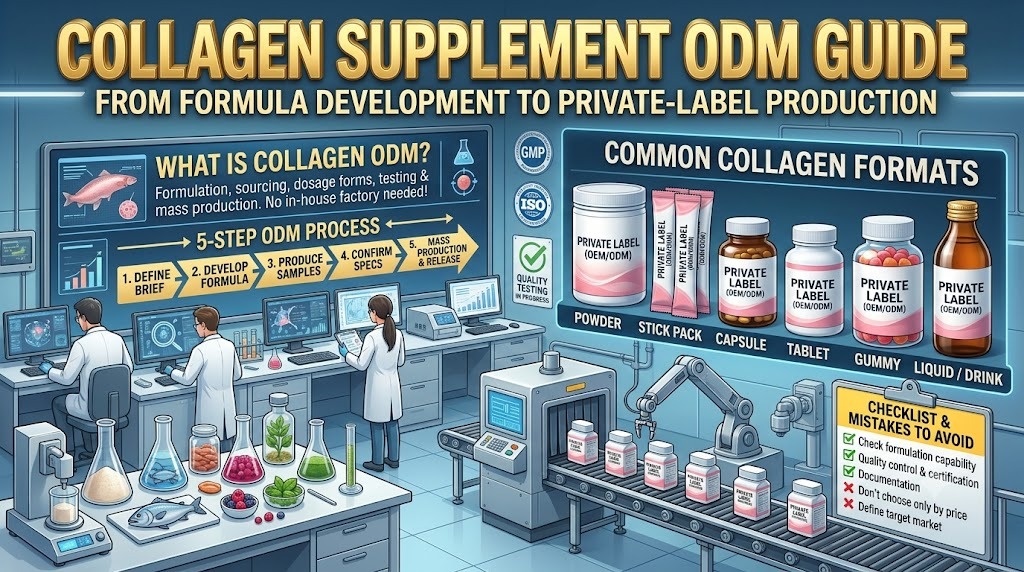
Common Collagen Supplement Formats: Which One Fits Your Product?
Selecting the dosage form is one of the earliest decisions in a collagen supplement ODM project because the format influences serving size, ingredient capacity, consumer experience, packaging cost, manufacturing process, and logistics.
| Format | Key Characteristics | Development Considerations | Typical Positioning |
|---|---|---|---|
| Powder | Allows a relatively large serving quantity | Flavor, aroma, solubility, sweetness, and packaging | Daily beauty or wellness routines |
| Stick Pack / Sachet | Portable and portion-controlled | Fill weight, film selection, sealing, carton configuration | Travel, office, and subscription products |
| Capsule | Simple consumption experience | Ingredient volume and number of capsules per serving | Convenience-focused supplement lines |
| Tablet | Stable solid dosage format | Compression, tablet size, hardness, and swallowability | Traditional supplement programs |
| Gummy | Consumer-friendly format | Ingredient capacity, flavor, texture, sugar system, and stability | Lifestyle-oriented consumer brands |
| Liquid / Drink | Ready-to-consume format | Flavor, preservation strategy, packaging, stability, and logistics | Premium beauty and functional beverage concepts |
Common Mistakes When Choosing a Collagen Supplement ODM Manufacturer
Choosing a collagen supplement ODM manufacturer only by comparing unit prices is one of the easiest ways to create problems later. The lowest quotation may not include the same formula specification, testing scope, packaging configuration, ingredient grade, development service, or documentation.
- Choosing only by price: Compare the full specification rather than a single unit price.
- Not defining the target market: Regulatory and labeling requirements differ between countries and regions.
- Ignoring collagen source: Confirm the source, specification, documentation, and suitability for your intended positioning.
- Adding too many ingredients: More ingredients do not automatically create a better product and can complicate taste, serving size, stability, and cost.
- Skipping sample evaluation: A specification on paper cannot fully represent taste, texture, aroma, or user experience.
- Ignoring packaging early in development: Packaging can influence MOQ, lead time, logistics, shelf presentation, and total project cost.
- Using unsupported marketing claims: Product positioning and label copy should be reviewed against the rules applicable in the intended sales market.
Advanced Tips and Best Practices for Collagen Supplement ODM Projects
1. Start With the Customer, Not the Ingredient List
A common development mistake is starting with a long list of trendy ingredients before defining who will actually buy the product. A stronger brief begins with the consumer, usage scenario, desired serving format, price range, and sales channel. Ingredient selection should support that product strategy.
2. Ask for Specifications and Supporting Documentation
Ingredient identity, quality specifications, certificates of analysis where appropriate, finished-product specifications, testing plans, and production records are important parts of supplement manufacturing. The exact documentation package will depend on the product and market, but brands should understand what documents can be provided before placing a large commercial order.
3. Compare Total Project Cost, Not Only Manufacturing Cost
The total cost of a collagen supplement ODM project may include formulation, samples, raw materials, packaging, printing, testing, freight, cartons, tooling, artwork changes, minimum purchasing quantities, and inventory commitments. Two manufacturers can quote very different unit prices because the scope of service is different.
4. Confirm the Regulatory Route Before Finalizing the Formula
A product intended for one market should not automatically be assumed to meet the rules of another. Ingredient status, permitted claims, labeling structure, required declarations, and manufacturing expectations may differ. For products intended for the United States, for example, dietary supplement manufacturing is subject to applicable FDA requirements, including dietary supplement CGMP provisions under 21 CFR Part 111. Brands remain responsible for ensuring that their products and labeling comply with applicable requirements.
5. Treat the ODM Manufacturer as a Long-Term Supply Partner
A successful product may eventually require repeat orders, packaging revisions, new flavors, market expansion, or line extensions. For this reason, supply stability, communication speed, change management, quality consistency, and the manufacturer's ability to scale can be just as important as the first production quotation.
Conclusion: How to Start a Collagen Supplement ODM Project
Collagen supplement ODM can help a brand move from a product idea to commercial production by combining formulation development, ingredient sourcing, sampling, manufacturing, packaging coordination, quality control, and documentation within a more integrated workflow. It can be particularly valuable for companies that understand their target market but do not have an internal supplement R&D and manufacturing team.
The most important step is not finding the manufacturer with the longest product catalog. It is finding a collagen supplement ODM partner whose capabilities match your actual project. Before requesting a quotation, prepare your target customer, intended market, dosage form, desired ingredients, packaging concept, target price, estimated order volume, and launch schedule. A clearer brief usually produces a more useful quotation and a more efficient development process.
Next Step: If you are planning a collagen powder, capsule, tablet, gummy, sachet, or functional beverage, prepare a basic product brief before contacting a collagen supplement ODM manufacturer. Include your target market, product format, preferred ingredients, estimated quantity, packaging requirements, and expected price positioning so the manufacturer can evaluate feasibility more accurately.